
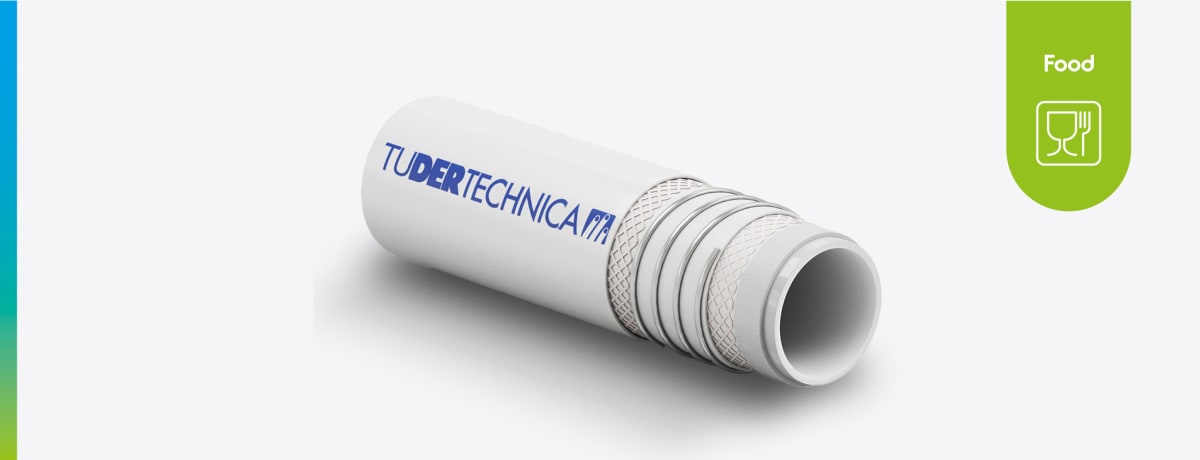
Which hose fits your critical applications in Pharma, Food & Industry?
In environments where hygiene, sterility and reliability are essential, the right hose is more than just a transfer component – it is a critical part of process safety. This article explains what to consider when selecting process hoses for demanding applications in the food, pharmaceutical and chemical industries.
1. Key selection criteria for process hoses
When selecting a process hose, several factors are essential:
Working pressure
Ensure the hose can withstand the maximum operating pressure.
Temperature resistance
Depending on CIP/SIP processes or the medium itself.
Chemical resistance
Especially important for acids, alkalis or solvents.
Required length and flexibility
Consider available installation space and movement.
Type of coupling
Compatible with standards such as DIN 11864, DIN 11853, DIN 32676 or DIN 11851.
A standard solution is not always sufficient. That’s why Rodesta offers customised options when needed.
2. Material selection: which hose for which medium?
Rodesta supplies process hoses in a wide range of materials suitable for various chemical and thermal loads:
| Materiaal | Temperatuurbereik | Eigenschappen |
|---|---|---|
| NBR | -30°C to +120°C | Oil-resistant, cost-effective |
| HNBR | -40°C to +150°C | High mechanical strength, suitable for hot media |
| EPDM | -50°C to +150°C | Resistant to steam, CIP/SIP and cleaning agents |
| BUTYL | -40°C to +120°C | Resistant to fats and vegetable oils |
| VMQ (siliconen) | -60°C to +200°C | Odourless, tasteless, highly flexible |
| FKM (Viton®) | -20°C to +250°C | Highly chemically resistant |
| UPE | -20°C to +100°C | Abrasion-resistant, good chemical resistance |
| PTFE (Teflon®) | -70°C to +260°C | Maximum chemical resistance |
Available in diameters from 10 mm to over 400 mm.
3. Standards and couplings: what fits where?
The right coupling is essential for a safe and hygienic hose connection. Rodesta supplies and assembles couplings according to:
- DIN 11864 (aseptic – threaded, flange, clamp)
- DIN 11853 (hygienic – threaded, flange, clamp)
- DIN 32676 (hygienic – Tri-Clamp)
- DIN 11851 (hygienic – also known as dairy coupling)
Depending on the industry and application, we recommend the most suitable coupling and corresponding process hose.
4. Assembly and quality assurance
The entire assembly process takes place in our modern production facility. We:
- Select the correct hose and coupling
- Cut the hose to the required length
- Engrave the ferrule with a unique identification code
- Crimp the ferrule with 0.1 mm precision
- Perform visual and technical quality checks
- Provide a pressure or leak test certificate upon request
Full traceability
Each assembly is traceable to its production and assembly moment thanks to our unique engraving. This ensures maximum control and safety.
5. Custom advice: what we need from you
Choosing the right process hose starts with a thorough understanding of your process. Key factors include:
- Medium (liquid, gas, steam)
- Temperature and pressure
- Chemical properties
- Cleaning methods (CIP/SIP)
- Movement or vibration conditions
Conclusion
In critical applications within the food, pharmaceutical, and chemical industries, selecting the right hose is essential. Only a carefully chosen hose — precisely cut to length and fitted with accurately crimped couplings — can ensure hygiene, safety, and process reliability. Rodesta combines technical expertise with years of experience in hose assembly and full traceability. Whether your process involves CIP, SIP, chemicals, or sterile environments — we provide reliable hose solutions that meet the most stringent standards.
Frequently Asked Questions (FAQ)
Which hose is best suited for CIP or SIP cleaning?
EPDM or PTFE hoses are highly suitable for CIP and SIP processes due to their temperature resistance and chemical compatibility.
Can Rodesta supply custom-made hoses?
Yes, we deliver tailor-made hose assemblies, including couplings and laser marking. If needed, we work with the manufacturer to develop a custom solution for your specific application.
What is the lead time for an assembled hose?
IIn most cases, we can deliver within a few working days. For custom-built solutions, the lead time depends on complexity and material availability.
Are all hoses supplied with a certificate?
Upon request, we provide a pressure and/or leak test certificate. All hoses are marked with a unique identification code for full traceability.
Does Rodesta also assist in selecting the right coupling?
Zeker. Wij adviseren u over het juiste koppelingstype op basis van de normeringen die gelden binnen uw sector en toepassing.
Absolutely. We advise you on the appropriate coupling type based on the standards relevant to your industry and application.
