Which coupling, valve and hose are right for your Industry?
In industries where reliability, safety, hygiene and aseptic are paramount, selecting the correct coupling, valve or hose is essential. Each process places specific demands on materials, sealing technology and connection standards.Rodesta is happy to guide you through the world of DIN couplings, industrial fittings, and hygienic or aseptic standards.This article provides an overview of which couplings, valves and hoses are suitable for Pharmaceutical applications, the Food industry, and (chemical) Industrial processes.
Pharmaceutical industry

In pharmaceutical processes, sterilization and safety are non-negotiable. Hoses, couplings and valves must not only be chemically resistant but also withstand intensive cleaning and sterilization. Documentation and traceability are crucial for audits and validation. For that reason, this sector almost always opts for solutions that meet the highest standards in aseptic design and cleanability.
The pharmaceutical sector places the highest demands on asepsis, sterility and traceability. Components must meet strict validation requirements and international standards such as GMP and USP Class VI. Materials must endure frequent cleaning and sterilization processes (CIP/SIP) without causing contamination.
Recommended couplings and fittings
DIN 11864-2 and DIN 11864-3
High-quality flange and clamp couplings for aseptic processes, commonly used in pharmaceutical and biotech installations that must comply with GMP standards.
ASME BPE
ASME BPE (Bio Processing Equipment) is the world’s leading standard for aseptic design in the pharmaceutical industry. The standard specifies wall thicknesses, surface finish (Ra values), tolerances and welding procedures for piping systems. Couplings according to ASME BPE are commonly used in systems where validation, traceability and aseptic integrity are critical. They are designed for easy cleaning and sterilization (CIP/SIP) and are often used with clamp fittings similar to DIN 32676.
Recommended valves
Aseptic check valves
Dead-leg-free design, ideal for sterile applications. Comply with the strictest CIP/SIP cleaning requirements and are essential for systems where backflow must be avoided.
Diaphragm valves
The standard in pharma due to their sterile and aseptic design. The flexible diaphragm provides physical isolation, minimizing contamination risk. Fully compatible with GMP, CIP and SIP.
Recommended hoses
- Smooth inner tube and low diffusion materials such as silicone, UPE or PTFE (Teflon®)
- Suction and discharge hoses with excellent chemical resistance
- Uitzonderlijke chemische bestendigheid
- Full traceability (batch and heat number)
- Compliant with FDA, EC 1935/2004, USP Class VI and ISO 10993-5:2009
In the pharmaceutical industry, hoses are almost always crimped with aseptic couplings in accordance with DIN 11864-2 (flange), DIN 11864-3 (clamp), or Tri-Clamp (ASTM A270, DIN 32676, or ISO 1127), depending on the process design and validation requirements. These couplings meet the highest standards for cleanability, sterility, and full traceability, and are suitable for CIP and SIP procedures.
Food industry
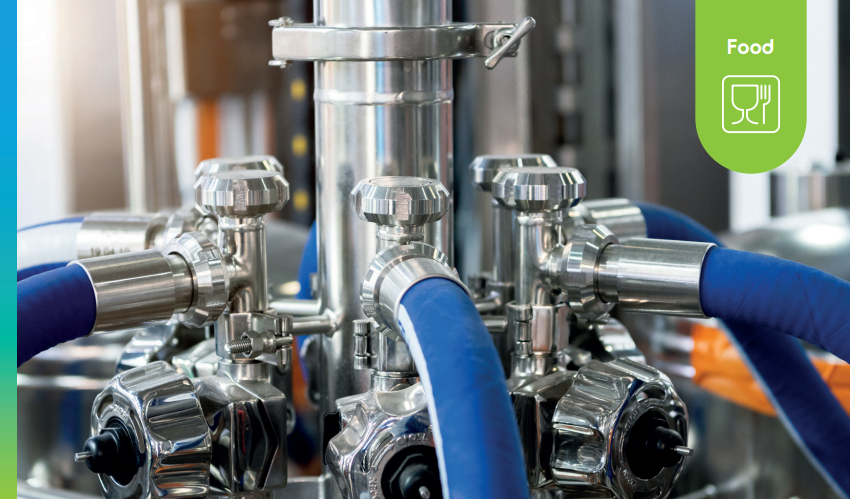
The Food industry requires components that are easy to clean and disassemble, without compromising hygiene or safety. Production processes range from cold beverages to hot dairy, and from highly acidic to fatty products. Therefore, hoses and couplings must be resistant not only to the product itself but also to cleaning agents, temperature fluctuations, and pressure.In this sector, hygiene, cleanability, and ease of disassembly are essential. Components must be compatible with CIP/SIP cleaning processes.
Recommended couplings and fittings
DIN 11851
Widely used hygienic screw coupling in the food, beverage and chemical industries. Easy to assemble/disassemble and suitable for regular cleaning. A D-ring seal ensures leak-proof, hygienic connections.
DIN 11864-series (1/2/3)
Screw, flange and clamp couplings for critical food applications.
DIN 11853-series (1/2/3)
Designed for hygienic (non-aseptic) food processes; meet high cleanability requirements without requiring full aseptic sterility.
DIN 32676 (Tri-clamp)
Common clamp coupling in food processing, easy to (dis)assemble, and suitable for CIP/SIP.
DIN 11852
Weld fittings such as T-pieces, 90° and 45° bends, reducers, and other connection components. Suitable for stainless steel piping systems that must meet strict hygienic requirements.
Recommended valves
Ball valves (dead-leg-free)
Prevent product residue and bacterial buildup; suitable for hygienic/aseptic applications and CIP/SIP. Available in various high-finish configurations.
Butterfly valves
Compact, easy to operate, and suitable for CIP/SIP; widely used in the dairy, beverage and food industries.
Check valves
Prevent backflow and are essential for safe operation in hygienic systems.
Recommended hoses
- Inner tube materials: NBR, HNBR, BUTYL, EPDM, silicone, UPE or PTFE
- Suitable as suction and discharge hoses, with temperature resistance up to 200 °C
- Compliant with FDA, EC 1935/2004, USP Class VI, ISO 10993-5:2009
- Press-assembled with couplings according to DIN 11851, DIN 11864 or Tri-Clamp (DIN 32676)
Chemical & industrial sector
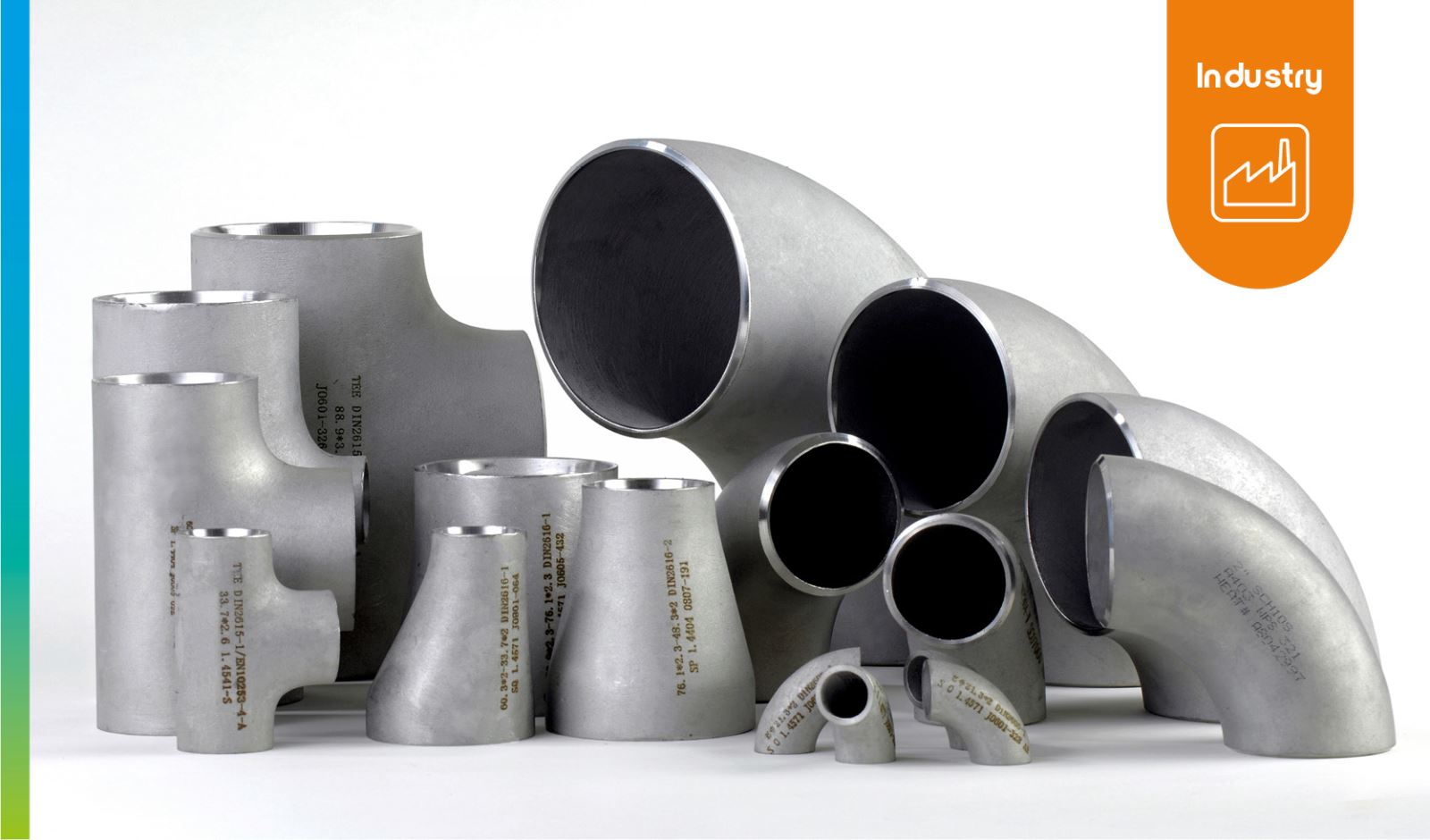
In chemical and industrial applications, robustness, durability, and safety are paramount. Products may be aggressive, abrasive, flammable, or subject to high pressure and temperature. Choosing the right materials is essential to prevent failure, leakage, or damage to equipment. Asepsis is rarely a requirement in these environments, but chemical resistance, pressure resistance, and antistatic properties are all the more important. The focus here is on process safety, chemical and pressure resistance. Aseptic design is generally not required. Component selection is based on resistance to aggressive media and mechanical stress.
Recommended couplings and fittings
BSP and NPT threaded fittings
Common threaded connections for pressurized industrial systems.
Flanged connections according to EN 1092-1 / ASTM A182
Robust coupling solutions for high-pressure piping.
Recommended valves
Industrial ball valves
Designed for high pressure and temperature; suitable for aggressive chemical media.
Butterfly valves
Often used in larger piping systems for flow regulation.
Check valves (swing/in-line)
Prevent backflow and protect pumps and pipelines.
Recommended hoses
- Chemically resistant inner linings: EPDM, FKM (Viton®), UPE, PTFE (Teflon®), FEP
- Suction and discharge hoses designed according to EN 12115 for chemical products
- Reinforced with steel spiral or braiding for high-pressure applications
- Temperature resistance depending on medium and process, typically up to +200 °C
- Industry-standard hoses with optional antistatic properties
- Press-assembled with couplings conforming to BSP, NPT or flange standards (EN or ANSI/ASME)
These solutions are designed for use in industries such as chemicals, energy, water treatment, tank farms, and general processing. Rodesta supports you in selecting reliable components that meet European and international standards like EN, ASTM, BSP or NPT.
Conclusion
From dairy production lines and pharmaceutical cleanrooms to industrial mixing systems – every sector demands tailored hose and coupling solutions. Rodesta offers a precisely selected range that meets international standards such as ASME BPE, DIN 11864, DIN 11853, DIN 32676, DIN 11852, EN and ASTM. Get in touch with our experts for tailored advice.
Frequently Asked Questions (FAQ)
Which standards are most important for pharmaceutical applications?
DIN 11864-2, DIN 11864-3 and ASME BPE are the most widely used standards for aseptic couplings. They ensure high cleanability, CIP/SIP resistance and full traceability.
What is the difference between DIN 11864 and DIN 11853?
The difference lies in the length of the weld ends:
- DIN 11864 components have long weld ends, suitable for orbital welding. This version allows controlled heat input and minimizes burn-in. It is ideal for aseptic applications in the pharmaceutical industry where validation and traceability are required.
- DIN 11853 components have short weld ends, intended for standard TIG welding. This version is commonly used in hygienic processes in the food industry where asepsis is less critical.
Can I use Tri-Clamp fittings in the food industry?
Yes, Tri-Clamp couplings (DIN 32676) are commonly used due to their easy assembly and cleanability. They are suitable for CIP/SIP and meet food safety standards.
Which hose materials are suitable for chemical applications?
EPDM, FKM (Viton®), PTFE, UPE and FEP are widely used. PTFE with stainless steel couplings is often chosen for maximum chemical resistance.
Which standards apply in the industrial sector?
Common standards include EN (e.g. EN 1092-1 for flanges), ASTM (e.g. ASTM A182), and thread types such as BSP or NPT. Chemical hoses often comply with EN 12115.
Which certifications are relevant for hose assemblies?
Depending on the application: FDA, EC 1935/2004, USP Class VI, ISO 10993-5:2009. For chemical applications: EN 12115. Traceability via batch or heat number is often required.
Rodesta offers an extensive range of stainless steel components directly from stock, in DIN, ISO and INCH dimensions, including compatible accessories. If you need advice on selecting the right coupling, valve or hose for your application, our technical specialists will be glad to assist you.
